Photograph the cards
Take a photo of each completed card at the desk. They queue and read while you carry on with the next one.
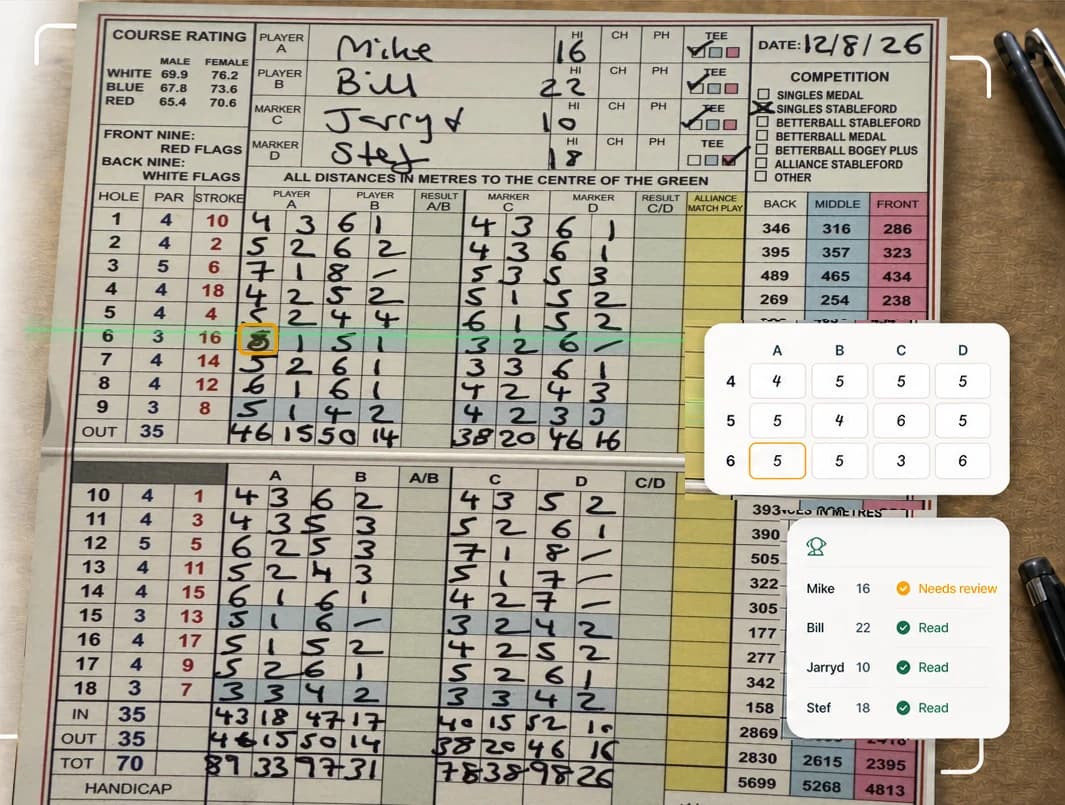
Golfers play the round exactly as they always have. Photograph the handwritten cards afterwards and ScribbleScore reads the scores, flags anything uncertain, applies the competition rules and builds the leaderboard.
Fifty seconds, with sound. The whole script is written out below it.
Less admin for organisers. No new process for golfers.
Median across the four-player 18-hole cards we have processed to date. Reading happens on our side, so the desk keeps photographing while earlier cards run.
360 individual hole scores across six handwritten four-player cards, every one verified by hand first. Measured August 2026. The other engine we tested scored 357 of the same 360, which is one cell apart and not a difference this sample can resolve. An internal benchmark, not a field trial, and anything the engine is unsure of is still flagged for a human.
74 of them cover the scoring engine: Stableford, allowances, every supported format, countback over 9 and 18 holes and shared ranks. The rest cover reading cards, member import, course layout, the draw, and the season standings and what a round contributes to them.
All three are our own measurements on our own sample, not a field trial across clubs, and none of them describes a card going through unseen: anything the reader is unsure of is still flagged for a person to check before a result is published.
ScribbleScore is early. When clubs are willing to be named, they will appear on this page and nowhere before it. Everything above is a number we measured ourselves and can show you.
ScribbleScore takes the repetitive work and brings you in only where judgement is actually needed.
Take a photo of each completed card at the desk. They queue and read while you carry on with the next one.
The clear scores go through. The handful that are genuinely doubtful come to you, beside the card they came from.
Rules and allowances are applied, the committee approves, and players open a clean result from a link.
ScribbleScore does not pretend every handwritten mark is perfect. It reads the clear scores, and where a digit is genuinely ambiguous it says so instead of guessing.
The digit on hole 7 could be a 6 or a 5. The same writer's 6 on hole 2 closes at the top; this one does not.
Resolve all three and watch the gate open. This is the real interaction, on synthetic data.
ScribbleScore runs an HNA-compatible workflow. It scores your competition from the handicaps you give it and keeps a reviewed record of what was played. It does not submit official scores, does not issue a Handicap Index, and is not integrated with HNA.
They play the round as always and open the result from a browser link. No account, no download, no second handicap identity.
Who changed what, and when, attached to the published result, so a committee settles a query from the record.
Golf clubs, societies and golf-day organisers, whether that is a monthly medal or a charity day with sponsors.
A player-round is one player's score processed for one round. Card equivalents assume four players to a fourball card. All prices exclude VAT.
up to 500 player-rounds a month · about 125 cards
up to 1,000 player-rounds a month · about 250 cards
Larger groups or volumes · quoted on the season
Running a society or a one-off golf day? The same product, set up for your field and quoted on a society or golf-day basis.
No, but it has to be readable. A card photographed flat, in reasonable light, with all the holes in frame is what you are aiming for.
If the photo has a problem, ScribbleScore says which one: glare, blur, shadow, or an edge cut off. It tells you rather than quietly guessing through it, so you can retake that card while the person who handed it in is still standing there.
About 45 seconds for a four-player card. Cards are read on our side rather than on your phone, so you can keep photographing while earlier ones are still being read.
Accurate enough that reviewing a card is quicker than typing one, and built so that where it is unsure, it says so instead of guessing.
Every value it reads carries its own confidence score. Where a digit is ambiguous it records what else it could be, and it pays particular attention to the handwriting confusions that actually matter on a scorecard: 3 against 5, 1 against 7, 4 against 9, 6 against 0 and 2 against 7. Anything it is unsure about is read a second time, on its own, before you are ever asked about it.
We do not publish a single headline accuracy percentage, because the number that matters is how many cells you have to check on your cards, not on ours.
No. That is the entire point. ScribbleScore brings you the values it is unsure about and the ones that disagree with something else on the card, and leaves the rest alone.
There are nineteen kinds of exception, split into two groups. Must-fix ones, like a missing score or a name nobody can read, stop the card being marked as checked. Worth-a-look ones, like a total that does not match the holes, are shown to you but do not block anything.
No. That is a deliberate design decision, not a limitation. A player opens a link in their browser and sees the result. No account, no download, no password.
If someone wants it on their home screen they can add it, and it opens full screen like an app. That is their choice, not a requirement, and nothing is withheld from people who do not.
No, and we are careful about how we describe this. GolfRSA is the official World Handicap System authority in South Africa and HNA operates the technology behind it. They hold the official handicap relationship with the golfer, and they calculate the official Handicap Index.
ScribbleScore works alongside that. It runs an HNA-compatible workflow: it uses the handicaps you give it to score your competition, and it produces a reviewed record of what was played. It does not submit scores for official handicap purposes, it does not calculate an official Handicap Index, and it is not integrated with HNA.
The most useful demo is your own scorecard, your own formats and your own handwriting. Book a session and we will run it against a card like yours while you watch.